
Read Leslie County Property Tax Stages
In Leslie County, tax records start with the PVA assessment. Collection then moves to the sheriff, and delinquent bills eventually transfer to the county clerk. The keeper of record changes at each stage, so no single portal answers every tax question about a parcel.
| Field | What It Shows | Where |
|---|---|---|
| Owner and parcel | January 1 roll identity and tax-map key | Leslie County PVA |
| Land and improvements | Separate assessment components and total | PVA parcel card |
| Fair cash value | The Kentucky assessment standard | PVA assessment roll |
| Exemption | Qualified reduction applied to the assessment | PVA record and application |
| Current bill and payment | Amount, discount, penalty, and collection status | Leslie County Sheriff |
| Delinquent certificate | Transferred unpaid bill and later sale activity | Leslie County Clerk |
Keep the pieces in their lanes. An assessment is not the sale consideration recorded in a deed, and a tax bill is not an appraisal. When a sale date or current owner matters, trust the newest recorded deed.
Leslie Taxes Begin with the PVA
The Leslie County PVA is listed as Jeff Boggs in current PVA sources. The office keeps assessments, ownership changes, and tax maps. From there, the Leslie QPublic application hosts the parcel search. It presents its disclaimer before search results. Plan to look for the owner, mailing address, situs, parcel number, legal-description shorthand, land value, improvement value, total assessment, exemptions, last-sale fields, and map.
Write down the assessment year. Note the date you pulled the parcel card, since the roll changes annually.
January 1 Controls the Leslie Assessment Snapshot
Kentucky fixes one date for real property assessment: January 1. Each year the Leslie County PVA updates the tax roll on that basis. Physical examinations of property run on a four-year cycle. New construction and other changes can shift values between those visits. The result is a snapshot tied to a single date, not a running ledger.
That timing explains a common puzzle. A deed recorded after January 1 can name a different owner. The tax roll shows the prior owner for that year. The roll reflects the assessed date. A newer recorded deed is later evidence of who owns the parcel. Compare dates before assuming an error.
Kentucky's assessment process targets fair cash value. Look past names and numbers to the effective date. That detail settles most mismatches between deed records and the tax bill.
Note: A tax-roll owner is an assessment snapshot, not a substitute for the newest recorded deed.
Separate Leslie Assessed Value from Sale Price
Three different numbers travel with every Leslie County parcel. Fair cash value is the PVA's assessment standard, recorded consideration belongs to the deed, and the amount due follows from the taxable assessment and the applicable rates. A sale may also fall under a transfer-tax exemption, so a deed value should never be read as a full appraisal without context.
Assessed value: the figure the PVA places on a parcel. It drives the tax process. Fair cash value: Kentucky's standard for real-property appraisal. It is not a sale price. Levy or rate: the percentage taxing authorities apply. They apply it to assessed value. Tax lien: the claim that arises when a tax bill goes unpaid. Homestead exemption: a reduction a qualifying owner of record claims. It is claimed through the PVA.
Look Up Leslie County Tax Bills
The chain of custody for a Leslie County tax bill is simple. The PVA supplies the assessment, the sheriff collects the current year, and the clerk takes over delinquent bills and certificates. Leslie County publishes no separate public bill-payment search, so have the exact parcel number and tax year ready when you call the responsible office.
- Find the parcel and assessment year through the PVA or QPublic.
- Ask the Leslie County Sheriff about the current bill, discounts, penalties, and payment status.
- Confirm any exemption on the PVA assessment record.
- For transferred delinquency, ask the clerk for the bill number, certificate, assignment, release, and sale status.
- Current bill
- A bill still in the sheriff's collection cycle.
- Delinquent certificate
- An unpaid bill transferred to the clerk after April 15.
- Third-party purchaser
- A registered buyer of a certificate, not automatically the landowner.
- Release or assignment
- A later record showing satisfaction or transfer of the certificate interest.
Apply for Leslie's Homestead or Disability Exemption
The Kentucky Department of Revenue set the homestead exemption at $49,100 for 2025 and 2026. That figure is up from $46,350 for 2023 and 2024. To qualify, an owner must be 65 or older. Alternatively, the owner can be totally disabled under the state's requirements. Applications go through the Leslie PVA with the requested proof.
The exemption only changes the taxable assessment. It does not touch the deed, the legal description, or any actual market transaction. Confirm the correct year appears on the parcel record.
Follow Leslie Tax Delinquency Between Offices
Unpaid bills transfer to the county clerk after April 15. That is the first step in the state delinquent-tax process. From there, interest, clerk charges, attorney fees, notice, registration, and third-party sale can all follow. Leslie's older procedure is more detailed. It describes publication in Leslie County News. It also covers protected lists, purchaser registration, bill-number requests, and certificates recorded or assigned through the delinquent-tax system and the encumbrance book.
A certificate is not automatic ownership of the real estate. Trace redemption, assignment, release, litigation, and any later deed on their own.
The Advertised 2026 Leslie Tax Sale
The current Leslie County Clerk site advertises the sale of 2025 delinquent bills for September 28, 2026 at 10:00 a.m. Third-party registration is due September 18, 2026. These dates are time-sensitive. So recheck the current notice before relying on them.
The clerk also warns of a 3 percent credit-card convenience fee. Payment methods, protected bills, purchaser lists, and final charges should be confirmed directly with the office. Confirm these before sale day.
Note: Compare any private tax-sale solicitation with the current clerk notice and courthouse telephone before sending funds.
Appeal a Leslie County Property Assessment
Kentucky's property-tax calendar sequences the steps. Inspection of the roll comes first, then a PVA conference, then a county Board of Assessment Appeals filing. The taxpayer must request and complete the PVA conference before anything else. If the issue remains unresolved, file with the county clerk no later than one workday after the inspection period closes. Use the current state notice and local dates.
The Department of Revenue calendar is the official reference. It shows how assessment and appeal steps line up:
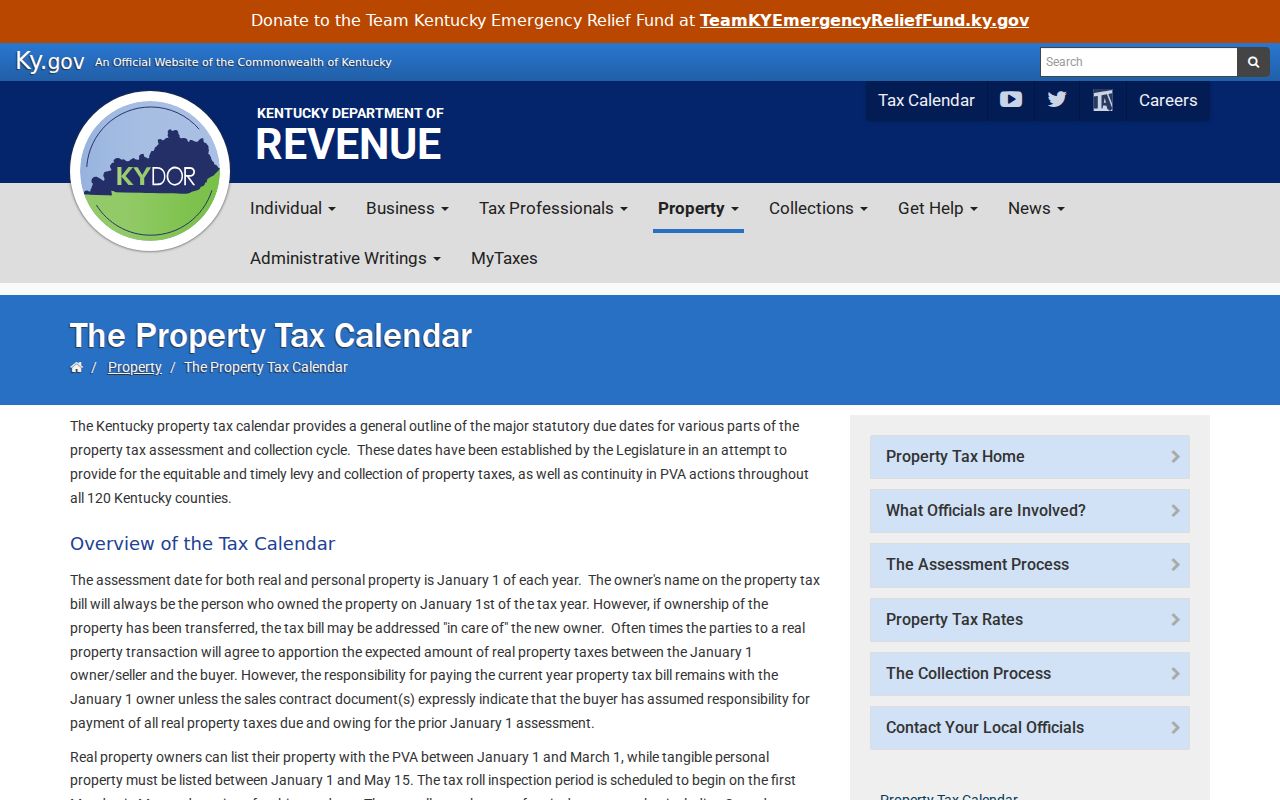
Check the calendar for the active year's dates. It supports the statewide sequence but does not replace a current Leslie PVA or county-clerk notice. Bring evidence tied to January 1 value: comparable sales, photographs, repair estimates, measurements, income information where relevant, and records showing factual errors. Keep the conference request and its result.
Appeal window. Complete the Leslie PVA conference first, then file with the county clerk by the state calendar's deadline; verify current inspection dates before acting.
Request Offline Leslie County Tax Records
Need Leslie County tax records by phone or mail? Call the PVA for assessment and exemption details. The sheriff at the courthouse handles current collection. The clerk at 606-672-2193 holds transferred delinquencies and tax-sale certificates. Whatever office you contact, a strong request should identify the parcel, the owner of record, the tax year, and the tax-bill number. Name the exact document you want as well.
The clerk's forms page offers a Request to Inspect Public Records you can use. Local policy sets a few ground rules. The staff does not perform research. Email requests are limited to Kentucky residents, and copies go out by mail. Kentucky's Open Records Act copy provision guarantees inspection and copies. That guarantee is subject to procedure, cost, format, and exemptions.