
Trace Leslie County Former Owners Backward
Start at the newest conveyance for the right tract. The Leslie County PVA parcel record through QPublic can show the current owner of record, the parcel number, situs, mailing address, and assessment. It sometimes includes a last-sale field too. Treat that as a lead only, not the ownership chain itself. Pull the newest deed at the Leslie County Clerk and read the grantee name. The grantor on that deed is your next former owner. The walk backward continues one instrument at a time.
| Source | Years It Covers | Where Held | What It Shows |
|---|---|---|---|
| Newest recorded deed | Current transfer | Leslie County Clerk | Grantor, grantee, deed type, legal description, source of title |
| FamilySearch deed books | 1879-1916 | Microfilm from courthouse originals | Earlier conveyances in twelve cataloged reels |
| FamilySearch deed indexes | 1879-1931 | FamilySearch catalog and courthouse | Name-to-volume and page routes |
| KDLA permanent series | Historic holdings vary | Kentucky Department for Libraries and Archives | Deeds, indexes, plats, wills, and court-related leads |
The online starting point and the historic finish are different channels. Leslie County publishes no public grantor-grantee search endpoint. No modern coverage cutoff applies. For recent deeds, work through the clerk counter, phone, mail, or a specific open-records request. Older stretches of a Leslie County ownership history live in the cataloged deed books. The official Leslie County Clerk site is the doorway to the office. That office holds the recent end of the chain.
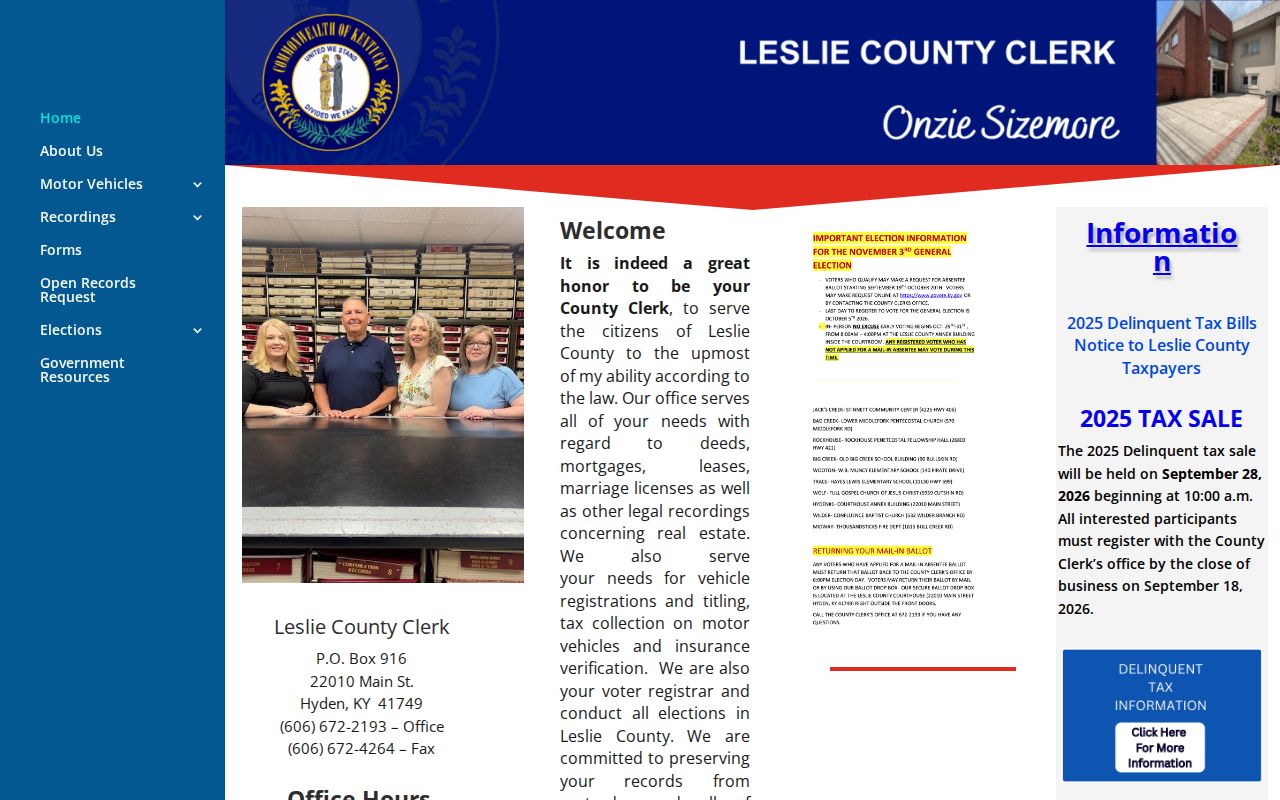
The page confirms the custodian and the contact route. It is not a searchable grantor-grantee index, so treat it as an address book rather than a deed records tool.
Use Leslie County Source-of-Title Clues
The Leslie County Clerk deed guidance requires a source-of-title statement on any instrument that passes title. That statement may point to a deed book and page. It may also point to another recorded source. Copy it exactly. Note the acreage, spouse names, each party's role, and the in-care-of tax-bill address too. These details keep a property search anchored to one tract. They also separate people who share a surname.
A return address, the PVA mailing address, a tax address on the tax roll, and the physical situs can all differ. Flatten them into one "property address" and the chain breaks. Keep every label distinct. Compare legal descriptions closely. Older Leslie County deeds may describe land by Rockhouse Creek, Middle Fork, a ridge, a road, or an adjoining owner rather than a street number.
Note: A source-of-title citation is a powerful next step, but it still must be checked against the cited instrument and tract.
Read Leslie County Former-Owner Deeds in Reverse
A backward chain makes the seller the subject of the next deed search. Start with an identified recent deed, not an old family name. At every step, record the same core facts. Note the grantor, the grantee, the deed book, and the page. Add the full legal description. That discipline keeps a name match from quietly pulling you onto the wrong parcel in Leslie County.
- Identify the current parcel and locate the current owner's acquiring deed, where that owner appeared as grantee.
- Copy the grantor, recording date, instrument type, source-of-title citation, and complete legal description.
- Search that grantor as a grantee in an earlier period, then compare acreage, boundary calls, spouse, and capacity.
- Repeat until the web-access gap is reached, then continue through courthouse indexes, deed books, microfilm, or KDLA.
- Grantor / grantee
- The person or entity conveying an interest / the person or entity receiving it.
- Chain of title
- The ordered run of instruments affecting ownership of the same tract.
- Reverse index
- An index organized by grantee, useful for finding how a former owner acquired the land.
- Warranty / quitclaim deed
- A warranty deed carries stated title covenants; a quitclaim transfers only the interest the grantor may hold.
Leslie County Former-Owner Deeds Begin at 1879
The FamilySearch Leslie deed catalog covers deeds from 1879 through 1916. It also covers indexes from 1879 through 1931 on twelve microfilm reels filmed from courthouse originals. Those endpoints differ. An index entry after 1916 may point to a deed volume outside the cataloged run. So the indexed instrument is not always in the same collection. Access may also require a FamilySearch login. Or it may require a visit to an affiliated library or center. The Leslie County Clerk still keeps the courthouse record itself. For copies, cite the volume and page from the index. Do not ask for every deed tied to a surname.
Note: The confirmed 1879 date is a catalog starting point, not proof that every surviving early Leslie instrument is online.
Trace Leslie Owners Into Parent Counties
Leslie County was formed in 1878 from parts of Clay, Harlan, and Perry counties. A source-of-title older than the county can therefore leave no trace in Leslie records. Nothing is missing in that case. The earlier instrument may sit in the parent jurisdiction. That parent county covered the land at the time. The first deed recorded in Leslie is not always the first conveyance of the tract. Carry the oldest Leslie legal description into the parent-county index. Waterways, acreage, natural calls, and neighboring owners often beat a modern parcel number for matching old tracts. Old catalogs may list the recorder as the "Clerk of the County Court." Current material says County Clerk. Search under both office names.
Probate Restores Leslie Former-Owner Chains
Not every ownership change was a sale. A death, will, estate settlement, fiduciary deed, partition, quiet-title action, or tax sale can break a tidy grantor-to-grantee chain in Leslie County deed records. A court-ordered transfer can too. The next deed may name an executor, administrator, trustee, commissioner, corporation, or LLC. Keep that capacity noted. Then look for the event that authorized the transfer. The Circuit Court Clerk handles filing and copies for court matters. KDLA Judicial Indexes offers historic plaintiff and defendant leads by county. CourtNet guidance covers modern searches. Probate, marriage, and death records can separate same-name people. Those records alone, though, do not convey the parcel. A deed or court order must still tie the person to the land.
Reach Offline Leslie Former-Owner Records
The county clerk in Hyden keeps the paper counter for Leslie County property records. Deeds, mortgages, easements, liens, releases, and plats all file there. Visit at 22010 Main Street in Hyden. Call 606-672-2193 first. A call ahead can confirm access and the exact volume a historical search needs, and a specific request may also be mailed to P.O. Box 916, Hyden, KY 41749. The clerk forms page links the open-records material.
A July 29, 2021 clerk policy sets a few ground rules. Staff do not conduct research. Name the document you want. Kentucky residents may email a request, while nonresidents should use mail. Paper copies run fifty cents a page. Open-records routes under KRS 61.870 through 61.884 still work for identifiable records, but a request lands hardest after the chain has yielded a name, date, instrument, book and page, or parcel clue. The official forms page shows where to obtain the request material for a precise historical-deed inquiry.
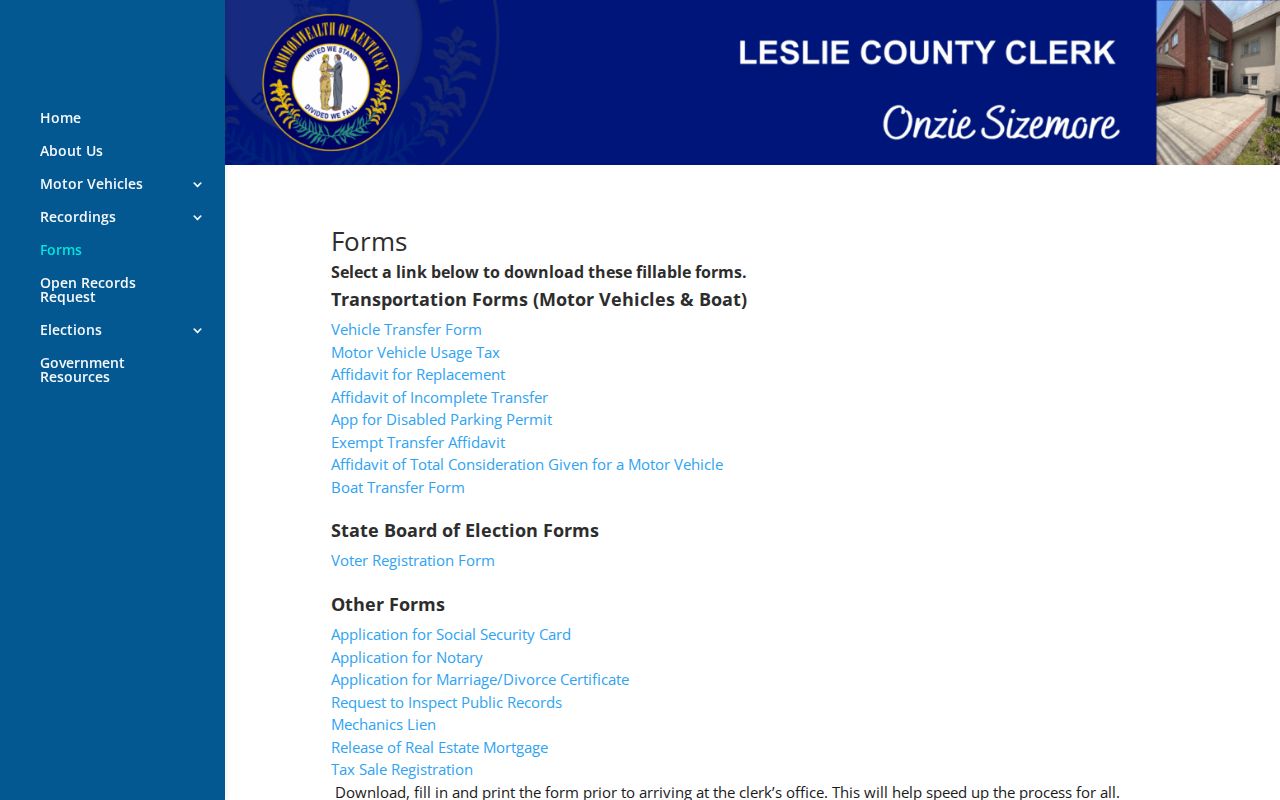
The offline path rewards preparation. Bring an instrument number, party name, date range, book and page, or parcel clue to the counter instead of asking staff to build the chain from scratch.
Offline is essential here. No public Leslie County deed-index URL or modern online cutoff was located, so the counter, phone, mail, microfilm, and archive routes are part of the normal search.
KDLA Extends Leslie Former-Owner Trails
The Kentucky Department for Libraries and Archives request service handles archive requests. It estimates a four-to-six-week turnaround. County inventories and retention schedules there identify permanent deed, general-index, plat, mortgage, and lien series. An archive copy serves research well. For a certified instrument, ask the office holding the authoritative record.
The Leslie County Public Library at 22065 Main Street in Hyden, 606-672-2460, makes a practical local stop for newspaper, obituary, directory, and FamilySearch access questions. Call ahead about its genealogy holdings. Such context can explain a family transfer or an old place name. It still cannot replace the recorded conveyance.
Match Leslie Names to the Same Land
A surname match alone proves little in these deed records. Names repeat across Leslie County's hills and hollows. Land details carry the proof. Acreage, road or water references, adjoining owners, lot and block, plat book and page, parcel splits, reservations, easements, and the source-of-title line all matter. Later deeds may convey only part of a tract. A spouse can appear because marital rights were released. That is not a sign each name marked a separate ownership period.
Build the house-history notebook one transfer per row. Record the recording date, grantor to grantee, deed type, book and page or instrument number, consideration if shown, acreage, legal calls, and a source citation. Flag uncertainties rather than forcing a clean line. That notebook lets you revisit the clerk or request a missing volume without repeating the whole property search.
How Far Leslie County Ownership Records Reach
Leslie County ownership records begin after the county's 1878 formation. Deeds start in 1879. Clay, Harlan, or Perry records hold earlier land history. The clerk publishes no online deed index, so a modern web cutoff cannot be pinned down. Let that shape the method. Prove the recent deed at the clerk, move backward by cited volume and page, then turn to microfilm, KDLA, parent-county records, probate, and court sources when the sequence changes channel.
Use records lawfully. Former-owner research supports house history, estate work, and purchase diligence. It is not permission to track, target, or harass a living person.